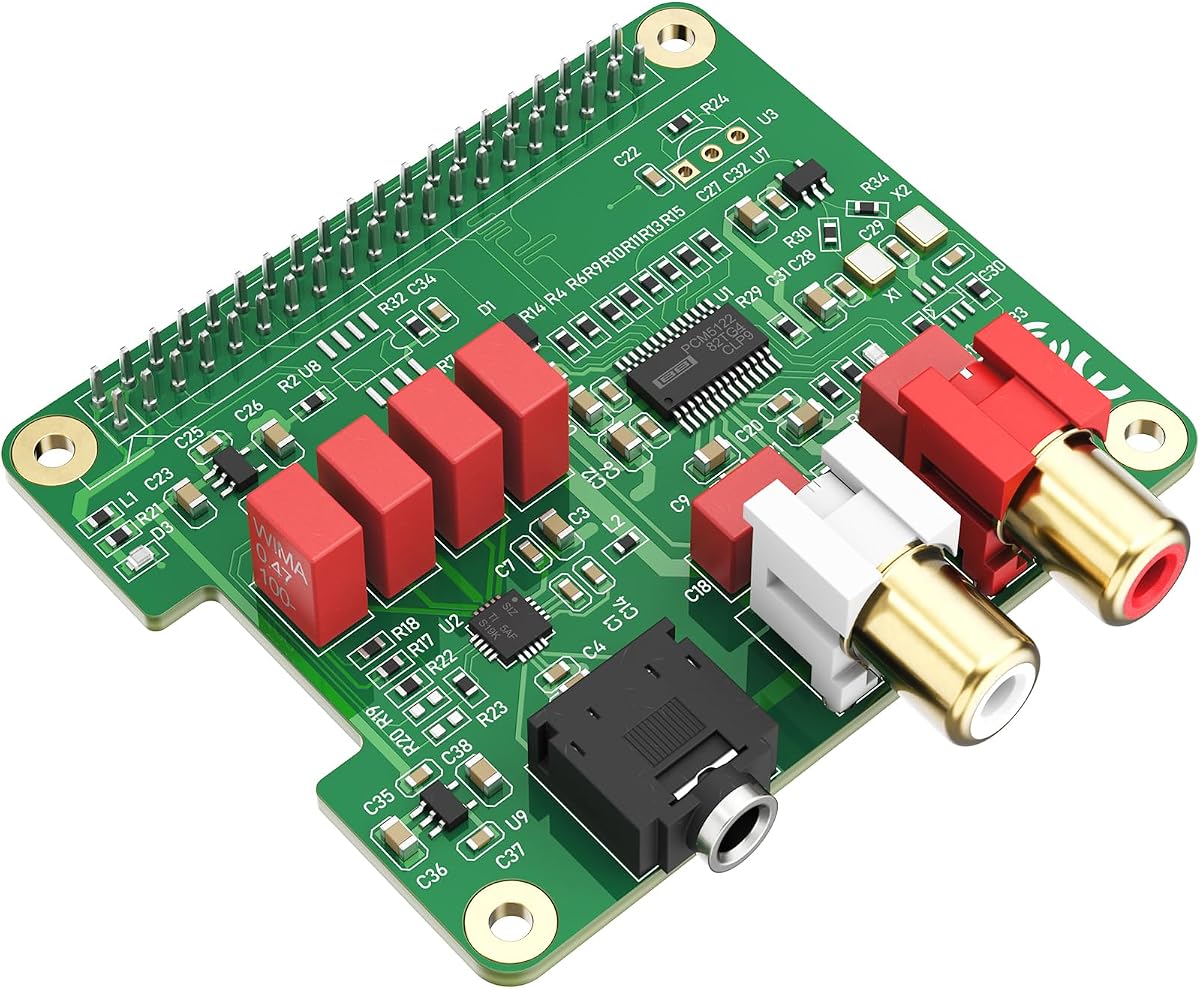
HiFi DAC HAT for Raspberry Pi 5/4/3B+/Zero
4.5Editor score
PCM5122 DAC chip
384kHz/32bit support
Dual RCA outputs
Discover the top DAC for Raspberry Pi options in this comprehensive guide comparing audio quality, compatibility, and value for your audio streaming projects.
Selecting the right DAC for Raspberry Pi transforms your single-board computer into a high-fidelity audio source. These expansion boards convert digital signals into analog sound, bypassing the Pi′s weak internal audio hardware for much clearer output.
We evaluated ten leading DAC HATs based on chip quality, supported sample rates, and software compatibility. Our analysis covers budget-friendly modules and premium boards designed for audiophile-grade streaming systems and home theater setups.
Each product entry details key specifications, pros, cons, and ideal use cases to help you decide. Prices and availability may fluctuate over time, so verify current listings before purchasing to ensure you get the best deal available today.
4.5Editor score

4.5Editor score

4.6Editor score
This side-by-side comparison highlights the core capabilities of each DAC HAT including chip type, supported sample rates, and connectivity options to help you find the perfect match for your specific Raspberry Pi audio build.


The HiFi DAC HAT stands out as a top contender for upgrading your Pi audio. With a 4.5 rating, this board offers professional-grade sound at an accessible price point for most hobbyists and enthusiasts.
We may earn a commission when you buy through this link, at no additional cost to you.
It leverages the TI PCM5122 DAC chip to deliver 384kHz/32bit resolution and 112dB SNR. The dual ultra-low jitter oscillators ensure timing accuracy, while the film capacitors and dual outputs support both RCA and headphone connections effectively.
While it lacks a dedicated headphone amplifier found in more expensive models, the output quality remains clean. The only physical constraint is ensuring your enclosure has enough height clearance for the board to stack properly.
This board is ideal for users seeking a balance between performance and ease of use. Whether building a network streamer or local player, it provides robust support across Volumio and Moode platforms.
Independent oscillators eliminate jitter from the Pi clock for purer sound reproduction.
Compatible with all major music server OS options including Volumio and RuneAudio.
We may earn a commission when you buy through this link, at no additional cost to you.
The DAC Mini Hat delivers impressive performance at a budget-friendly price point. It maintains full compatibility with all 40-pin Pi models including the compact Zero series where space is tight.
We may earn a commission when you buy through this link, at no additional cost to you.
Equipped with the PCM5122 DAC and TPA6133 amplifier, it provides 2.1Vrms output suitable for driving headphones cleanly. The dual gold-plated outputs offer flexible connection to speakers or audio systems.
While the build is straightforward, it challenges more expensive DACs in terms of noise floor. Users should expect slightly basic documentation compared to higher-tier boards but performance remains solid.
Choose this board if you need reliable audio performance on a tight budget. It is an excellent entry point for DIY audio enthusiasts wanting to upgrade from the Pi internal sound.
Specifically designed to fit zero models without overhanging for neat installations.
Delivers audiophile-grade sound quality that competes with more expensive alternatives.
We may earn a commission when you buy through this link, at no additional cost to you.
The HiFi DAC Pro Hat targets serious audiophiles with its flagship ES9038Q2M DAC chip. This board promises studio-quality bit-perfect sound with a 129dB DNR and deep support for high-resolution formats.
We may earn a commission when you buy through this link, at no additional cost to you.
It features dual ultra-low jitter clocks to ensure perfect timing accuracy. The board drives headphones powerfully via TI op-amps and offers balanced outputs for professional audio equipment integration.
While the price is higher, the features justify the cost for critical listeners. Setup may require some configuration to leverage DSD512 capabilities but the sound quality is exceptional.
This board is perfect for users building a high-end home audio system. If you need balanced outputs and DSD512 support, this is the premium choice for Pi-based audio.
The ES9038Q2M chip delivers industry-leading dynamic range and clarity.
Balanced outputs reduce interference for connecting to pro-grade audio equipment.
We may earn a commission when you buy through this link, at no additional cost to you.
The Digi One Hat excels as a digital output card for those using external DACs. It provides bit-perfect S/PDIF output with galvanic isolation to remove ground noise from the Pi.
We may earn a commission when you buy through this link, at no additional cost to you.
It supports 32 to 192kHz sampling rates and uses low jitter external crystal oscillators for accurate audio clocking. This ensures your external DAC receives a pristine signal for decoding.
While it does not produce analog sound directly, the isolation and clocking features make it a powerful upgrade. The digital isolation prevents electrical noise from corrupting the audio signal path.
Choose this board if you already have a quality external DAC and want to improve signal integrity. It is an essential component for high-end digital audio transport builds.
Complete isolation separates the Pi from the DAC to eliminate ground loop noise.
External oscillators ensure precise sample rates for better timing resolution.
We may earn a commission when you buy through this link, at no additional cost to you.
The HiFi DAC Audio Sound Card offers straightforward performance with helpful visual indicators. It uses the PCM5122 chip and I2S interface to deliver reliable audio playback for Pi projects.
We may earn a commission when you buy through this link, at no additional cost to you.
LED indicators show power and decode status making it easy to troubleshoot. The board provides standard analog outputs and supports a wide sampling rate for high-res audio.
While the design is basic, it delivers good SNR and THD for the price. It is a practical option for users who want visible status feedback on their audio board.
This board suits builders who prioritize function over form. The LED indicators provide immediate feedback on DAC health which is useful during development or testing phases.
Red and green LEDs clearly show power and decoding activity for easy monitoring.
Proven PCM5122 chip ensures stable playback across various music server setups.
We may earn a commission when you buy through this link, at no additional cost to you.
The RASPIAUDIO Audio DAC Hat offers a convenient plug-and-play experience thanks to its onboard EEPROM chip. This eliminates the need for driver installation and simplifies setup significantly.
We may earn a commission when you buy through this link, at no additional cost to you.
It delivers 32-bit/384kHz PCM playback with 112dB SNR for a clear sound. The colored PCB design adds a nice visual touch to your Pi case while ensuring universal compatibility.
While documentation is limited compared to some brands the plug-and-play feature makes up for it. Users will appreciate the ease of use across different Raspberry Pi models easily.
This board is ideal for those wanting a quick audio upgrade without complex configurations. It balances performance with simplicity making it a strong candidate for casual listeners.
EEPROM chip enables automatic detection so no drivers are needed for operation.
Works with Pi 5, 4, Zero v2, and earlier models without additional adjustments.
We may earn a commission when you buy through this link, at no additional cost to you.
The Argon BLSTR DAC is specifically engineered for the Raspberry Pi 5 ensuring optimal performance. It includes a ground loop isolator to help prevent unwanted hum and noise in your audio.
We may earn a commission when you buy through this link, at no additional cost to you.
Powered by the PCM5122 codec it delivers high-quality sound directly through a 3.5mm port. The 5.0 rating reflects user satisfaction with the noise reduction and audio clarity features.
While it is limited to Pi 5 users the included isolator is a significant advantage. This feature addresses common grounding issues that can degrade audio quality in home setups.
Choose this board if you own a Pi 5 and want an out-of-box audio solution. The isolator adds value by reducing noise risks without extra components.
Designed specifically for Pi 5 hardware to ensure perfect electrical and system compatibility.
Integrated ground loop isolator helps eliminate hum caused by power mismatches.
We may earn a commission when you buy through this link, at no additional cost to you.
The HiFiBerry DAC+ DSP stands out for its integrated Digital Signal Processor enabling real-time audio manipulation. It can upsample mix audio sources and apply room equalization dynamically.
We may earn a commission when you buy through this link, at no additional cost to you.
With a 300MHz DSP running 6144 instructions per sample it offers powerful audio processing. The asynchronous sample rate converter ensures high-quality conversion from any source rate.
While the price is high the processing capabilities justify it for advanced users. It can run standalone without the Pi via EEPROM though case compatibility is restricted.
This board is for enthusiasts needing room correction or signal processing. If you want to fine-tune audio characteristics on the fly this DSP capability is unmatched.
The DSP runs complex algorithms to adjust audio output without taxing the Pi CPU.
Built-in room equalization tools help tailor sound to your listening environment.
We may earn a commission when you buy through this link, at no additional cost to you.
The HiFiBerry Digi+ Standard is a trusted digital sound card delivering bit-perfect output via Toslink and Coaxial connections. It supports up to 192kHz/24bit resolution ensuring high fidelity.
We may earn a commission when you buy through this link, at no additional cost to you.
The dedicated S/PDIF chip guarantees the audio stream is never modified making it ideal for external DACs. Its sturdy design includes proper spacers for reliable stacking on the Pi.
While it targets older models primarily it remains effective for digital transport builds. The dual output options provide flexibility for different external DAC input standards easily.
This board is a reliable choice for digital transport builds needing optical or coax output. Its legacy status means strong community support and proven reliability over time.
Unmodified digital stream ensures your external DAC receives the original audio data.
Both optical and coax outputs give flexibility for different DAC hardware options.
We may earn a commission when you buy through this link, at no additional cost to you.
The HiLetgo PCM5102 module offers a very affordable entry into DAC HATs for Pi. It uses the PCM5102A chip to provide digital audio conversion that sounds much better than onboard audio.
We may earn a commission when you buy through this link, at no additional cost to you.
The stereo jack comes soldered onto the board already simplifying the wiring process. This makes it a convenient choice for quick tests or simple playback projects.
While audio quality is basic compared to premium boards it delivers solid performance for the price. Users should expect decent output without the refinement of higher-end components.
Choose this module for budget builds or prototype testing. It proves the value of I2S DACs without a significant financial investment or complex assembly.
Provides a significant audio improvement over standard Pi outputs at minimal cost.
Includes a pre-soldered stereo jack so you do not need to wire it manually.
We may earn a commission when you buy through this link, at no additional cost to you.
Selecting the right DAC HAT involves considering your audio goals, available space, and software needs. This guide breaks down the critical factors to help you make a confident purchase.
The DAC chip determines the baseline audio quality and resolution support. Chips like the ES9038Q2M offer flagship performance while the PCM5122 provides excellent value. Look for higher SNR and lower THD+N ratings for cleaner sound.
Prioritize boards with proven audio chips if quality is your main goal.
High-resolution audio requires DACs that handle 384kHz and 32-bit PCM. Some boards also support DSD formats like DSD64 or DSD512 for native playback. Ensure the chip supports your music library format for lossless streaming.
Check if the DAC supports your target resolution before buying.
Choose between analog outputs like RCA and 3.5mm or digital outputs like S/PDIF. Analog boards include headphone amps while digital boards need external DACs. Balanced outputs are available for high-end systems to reduce noise.
Select output types that match your speakers or external audio gear.
Verify the HAT works with your preferred music OS like Volumio Moode or OSMC. Most boards support EEPROM plug-and-play but check for specific driver needs. Universal OS support simplifies setup for most hobbyists.
Ensure full support for your chosen music server software.
Consider your enclosure and GPIO header compatibility. Some boards may overhang on Zero models so check dimensions. Proper spacing is required for the Pi to sit securely without stress on pins.
Measure your case height before purchasing a HAT board.
Timing jitter affects sound purity so look for external oscillators. Dual clock designs often produce better timing accuracy than internal Pi clocks. This is critical for audiophile builds demanding precise signal conversion.
Look for dual external clocks for the best audio timing accuracy.
Audio boards draw power from the GPIO pins which can strain the Pi supply. Low-power designs or separate power inputs help avoid instability or voltage drops. Ensure your PSU can handle the load of the board and Pi.
Use a reliable power supply to prevent audio dropouts.
Good documentation saves time during setup and troubleshooting. Check for online wikis manuals or community forums dedicated to the board. Open-source SDKs allow custom integration for advanced developers.
Choose a brand with accessible technical resources for support.
First install the HAT by aligning the GPIO pins carefully and pressing down until it sits flush. Secure it with standoff screws to prevent movement. Connect your speakers or headphones to the available analog output ports.
Next configure your operating system to prioritize the DAC audio device. Use tools like ALSAMixer to set the correct audio volume and routing. Install a music server software like Volumio to manage your media library remotely.
Keep the board cool and free of dust to maintain performance. Ensure your case allows airflow or add a small fan if running high-power amps. Periodically check connections for corrosion or loose contacts over time.
A DAC for Raspberry Pi is an expansion board that converts digital audio signals to analog sound. It connects to the GPIO header and provides much better audio quality than the built-in Pi audio port. These boards are essential for audiophiles using Pi music servers.
Most modern DAC HATs do not need drivers due to EEPROM plug-and-play support. However some advanced boards may require specific configuration files. Check the product manual for details on your specific OS setup steps.
Yes many DAC HATs fit the Pi Zero with compact designs. Ensure the board does not overhang and clears any case covers. Look for models specifically marked as Zero compatible before purchasing your board.
I2S is an internal digital interface used by analog DAC HATs for direct connection. S/PDIF is a standard for transmitting digital signals to external DACs. I2S boards play sound directly while S/PDIF boards send signals elsewhere.
Yes boards with built-in headphone amps can drive standard headphones directly. However high-impedance headphones might need a separate external amp. Check specs to see if the HAT includes an internal amplifier for output.
For high-res audio look for boards supporting 384kHz and DSD formats. The HiFi DAC Pro Hat and HiFiBerry DAC+ DSP offer superior resolution handling. These chips support deep bit depths and wide sampling rates for lossless playback.
Use a DAC HAT with galvanic isolation to separate the Pi from your audio gear. Alternatively use a ground loop isolator cable between the DAC and your amp. Proper wiring and dedicated power supplies also help reduce hum and static.
Installation is straightforward if you know how to insert a GPIO HAT. Align the pins and press firmly to attach it to the board. Secure with standoffs and configure your audio output settings to finish the setup.
We explored ten top DAC options ranging from budget-friendly modules to premium audiophile boards. Whether you need a simple upgrade or a high-end system there is a HAT for your build needs.
Prioritize audio quality, software support, and output type when selecting a board. Consider your budget and technical comfort level to ensure a smooth setup experience for your project.
Prices and availability can change so always check current listings before buying. Verify that your selected model matches your specific Pi model and case requirements for compatibility.