
10Gtek Gigabit SingleMode Fiber to Ethernet Media Converter
4.8Editor score
Dual SC Fiber Ports
20KM Transmission Range
UL Certified Power Supply
This guide compares the top Ethernet Fiber Media Converter options for extending network reach with fiber optics, reviewing performance, compatibility, and
Ethernet Fiber Media Converters are essential devices for extending network distances beyond copper limits. They bridge the gap between fiber optic cabling and standard Ethernet ports, enabling high-speed data transmission over long distances without signal degradation or electromagnetic interference issues.
We evaluated ten leading models based on speed capabilities, fiber type compatibility, ease of installation, and build quality. Our analysis focuses on real-world performance metrics, support features like link fault pass-through, and overall reliability for both small office and enterprise data center deployments.
Each selection highlights specific strengths such as gigabit speeds, dual-mode support, or advanced management features. Please note that availability and pricing may change frequently, so verify current stock and costs directly with the retailer before making your final purchasing decision for your network infrastructure.
4.8Editor score

4.7Editor score

4.7Editor score
The following table provides a side-by-side comparison of all ten selected Ethernet Fiber Media Converters. It highlights key specifications including fiber type, maximum transmission distance, port speeds, and unique features to help you identify the model that best fits your specific network extension requirements.
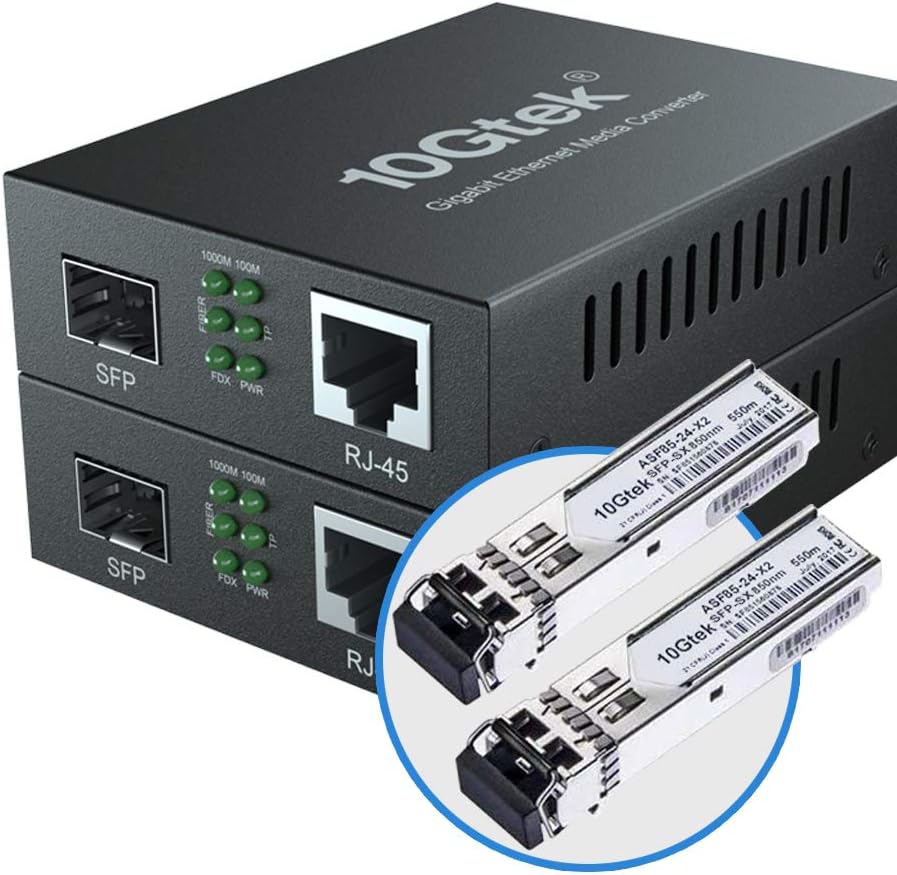


This 10Gtek Gigabit Ethernet Media Converter stands out as a top value option for network professionals needing a reliable link between fiber and copper. With a rating of 4.7, users praise its consistent performance and the convenience of receiving a pair of units ready for immediate deployment without extra component sourcing.
We may earn a commission when you buy through this link, at no additional cost to you.
The included SFP multimode modules operating at 850-nm ensure the fiber side is perfectly matched out of the box. The RJ45 port supports 10/100/1000Mbps auto-negotiation, making it versatile for various switches and routers. UL certification on the power supply adds a layer of safety for continuous operation in office environments.
While the 550-meter range is standard for multimode, it may not suit long campus links requiring single-mode reach. Additionally, the fixed 850-nm wavelength limits flexibility if you need to switch to different fiber types later. However, for typical office building extensions, these trade-offs are minor.
IT managers looking for a cost-effective solution to bridge fiber backbones with local Ethernet switches should consider this pack. It delivers solid gigabit performance with minimal setup, making it ideal for small to medium deployments where budget efficiency matters.
Receiving two converters allows you to establish a full link end-to-end immediately. This saves time and ensures compatibility between both ends without matching separate components from different manufacturers.
UL certification on the power supply indicates rigorous testing for electrical safety. This reduces risk of power-related failures, ensuring your network link stays stable during critical operations.
We may earn a commission when you buy through this link, at no additional cost to you.
The Omada Gigabit SFP to RJ45 Media Converter offers exceptional flexibility for network engineers who need to adapt to various fiber standards. Its hot-swappable FX port allows you to choose single-mode or multimode modules based on your specific distance needs, ranging up to 20 kilometers for single-mode transmission.
We may earn a commission when you buy through this link, at no additional cost to you.
Plug-and-play functionality ensures zero configuration hassle, while auto-negotiation handles half or full duplex modes automatically. The auto-MDI/MDIX feature means you never need crossover cables, simplifying cabling. This adaptability makes it a strong choice for heterogeneous network environments.
One downside is that SFP modules are not included, requiring you to source them separately. This adds to the upfront cost compared to pre-loaded units. However, the ability to swap modules later provides long-term value and reduces waste when network requirements change.
Professionals managing complex infrastructures with mixed fiber types will appreciate this converter's versatility. It balances cost with functionality, ensuring you can extend your gigabit network over significant distances without being locked into a single fiber specification.
Changing fiber modules without powering down the unit reduces downtime during maintenance. This feature is crucial for mission-critical links where continuous availability is non-negotiable.
Full compatibility with standard MSA-compliant modules ensures you have access to a wide range of third-party options. This prevents vendor lock-in and keeps your hardware costs manageable over time.
We may earn a commission when you buy through this link, at no additional cost to you.
This pair of 1.25G/s Bidi Gigabit Multi-Mode converters utilizes bidirectional technology to transmit data over a single strand of fiber. This unique approach can optimize fiber usage when you have limited strand availability, while still supporting standard multimode fiber standards effectively.
We may earn a commission when you buy through this link, at no additional cost to you.
The units come with Bidi SFP LC dual transceiver modules pre-installed, ensuring the optics match correctly for bidirectional communication. Supporting jumbo frames up to 9KB helps improve throughput for large file transfers and storage traffic. The wide voltage input range ensures stable operation globally.
Bidirectional optics are less common than standard duplex modules, which can make replacements harder to find later. The 550-meter limit also restricts long-distance use. However, for scenarios where fiber strand conservation is needed, this model offers a specialized and reliable solution.
Network administrators in older buildings with constrained fiber plants will find this converter particularly useful. Its robust warranty and comprehensive support provide peace of mind, making it a solid investment for maintaining legacy infrastructure without costly rewiring.
Using a single fiber strand for both sending and receiving doubles the effective capacity of existing cabling. This is invaluable when adding new fiber runs is physically impossible or too expensive.
Wide voltage input allows use in regions with different electrical standards without extra adapters. This makes deployment easier for organizations operating multiple international offices or branches.
We may earn a commission when you buy through this link, at no additional cost to you.
Designed for bandwidth-intensive environments, this 10G Ethernet Media Converter supports up to 10Gbps over fiber using SFP+ slots. It auto-adapts the RJ45 port to handle various speeds, from 100M to 10G, making it ideal for connecting high-speed servers or backbone switches without manual intervention.
We may earn a commission when you buy through this link, at no additional cost to you.
Diagnostic LEDs provide immediate visual feedback on link status and configuration settings. The optional DIP-switch features allow advanced users to tweak behavior like flow control or alarm functions. This level of detail ensures the unit integrates smoothly into managed network environments.
The primary drawback is the cost and requirement for specific 10G modules, which can be expensive. If your network only runs at 1G, this unit may be overkill. However, for future-proofing or current 10G needs, it offers unmatched performance in this category.
IT teams upgrading to 10G backbones should prioritize this converter to maintain high throughput. Its robust feature set and support for chassis mounting ensure it fits well into professional data center setups requiring stability and speed.
The copper port auto-sensing detects 100M to 10G connections automatically. This simplifies cabling upgrades as you move from legacy 1G switches to modern 10G hardware.
LED indicators and DIP switches help troubleshoot issues quickly without external monitoring tools. This reduces mean time to repair for network faults.
We may earn a commission when you buy through this link, at no additional cost to you.
This 10Gtek SingleMode converter delivers impressive range at an accessible price point. Supporting up to 20 kilometers over single-mode fiber, it bridges long campus links effectively. The high 4.8 rating reflects consistent performance and low failure rates reported by users in the field.
We may earn a commission when you buy through this link, at no additional cost to you.
The dual SC fiber ports are standard for many legacy single-mode installations, ensuring compatibility with existing SC-based infrastructure. UL certification guarantees safe power operation, while the included pair allows full link setup out of the box. Auto-negotiation on RJ45 handles diverse network devices seamlessly.
SC connectors are less common in modern deployments favoring LC, which might require adapters. The fixed modules limit future flexibility if you need different wavelengths. Yet, for fixed long-distance needs, this reliability and cost balance are hard to beat.
Campus network planners and facility managers needing reliable long-haul links should choose this model. It offers enterprise-grade distance capabilities without the high cost of premium chassis-based solutions.
Extending to 20KM covers most building-to-building connections. This eliminates the need for active repeaters, simplifying network architecture.
UL certification on the power supply protects against electrical hazards. This is crucial for devices running continuously in unstaffed locations.
We may earn a commission when you buy through this link, at no additional cost to you.
With a standout 4.9 rating, this converter pair offers exceptional reliability and ease of use. The built-in 1000Base-LX modules ensure immediate connectivity over single-mode fiber up to 20KM. Users appreciate the plug-and-play nature which requires no configuration or software installation to establish a link.
We may earn a commission when you buy through this link, at no additional cost to you.
LED indicators clearly show link activity and power status, simplifying monitoring. Support for 9K-byte jumbo frames helps optimize throughput for storage traffic. U.S.-based technical support provides direct access to experts during business hours, a valuable asset for troubleshooting complex issues quickly.
While the modules are built-in, limiting future swapping, this reduces complexity for most users. The lack of advanced configuration options means it might not suit highly specialized routing needs. But for standard network extension, it excels in stability and support.
Small business owners or managed service providers needing reliable gigabit fiber links will find this kit ideal. The high satisfaction score suggests low return rates and consistent performance in daily operations.
The 4.9 rating reflects real-world reliability. Users report fewer issues compared to other brands, ensuring minimal network interruptions.
U.S.-based support ensures clear communication during troubleshooting. This reduces downtime when technical assistance is needed urgently.
We may earn a commission when you buy through this link, at no additional cost to you.
This converter stands out for its convenience, shipping with the LC SFP module already fitted. This eliminates the risk of incorrect module installation or mismatching wavelengths. The unit supports Link Fault Pass-through, ensuring that if the fiber breaks, the copper link also drops to alert network equipment.
We may earn a commission when you buy through this link, at no additional cost to you.
Four rear DIP switches allow precise control over link behavior, including broadcast storm control and forced speeds. The wide temperature range allows deployment in diverse environments. Included wall-mount ears make physical installation straightforward for both desktop and rack setups.
The physical size is slightly larger than compact mini-units, which may matter in tight spaces. Some DIP features require technical knowledge to utilize effectively. Still, the included components and robust controls make it a top choice for professional installs.
IT professionals who want a reliable unit ready to work immediately without extra hardware purchases should buy this. The balance of features and convenience offers significant value over time.
The pre-installed module ensures the unit works immediately upon power-up. This saves time and reduces procurement complexity for quick network expansions.
LFP helps detect fiber faults by dropping the copper link automatically. This keeps switches aware of physical issues, speeding up network troubleshooting.
We may earn a commission when you buy through this link, at no additional cost to you.
Designed for enterprise reliability, this StarTech converter features an open SFP slot for maximum flexibility. TAA compliance makes it suitable for government and public sector projects requiring compliant hardware. Lifetime technical support ensures long-term assistance, which is rare at this price point.
We may earn a commission when you buy through this link, at no additional cost to you.
VLAN pass-through keeps tagged traffic intact, preserving network segmentation. The compact design allows wall or rack mounting via optional chassis. Link fault pass-through ensures fast troubleshooting in mission-critical deployments. Lab-tested design guarantees seamless integration with diverse network equipment.
The cost is higher than consumer-grade units, and separate module purchase adds upfront expense. However, for organizations needing guaranteed compliance and robust support, these are necessary investments. The durability matches enterprise needs well.
Government agencies and large corporations should choose this model for critical infrastructure. Its compliance features and support levels exceed typical consumer offerings, ensuring long-term stability and legal adherence.
Meeting TAA standards simplifies procurement for federal contracts. This avoids compliance hurdles that delay critical network upgrades.
Lifetime technical assistance ensures you can resolve issues years later. This reduces long-term operational risks and maintenance costs.
We may earn a commission when you buy through this link, at no additional cost to you.
This converter is optimized for multimode networks using OM1 to OM5 fiber grades. The pre-installed 1000BASE-SX module ensures alignment out of the box. It handles QinQ and 802.1Q tags transparently, preserving VLANs across the link without rewriting packets.
We may earn a commission when you buy through this link, at no additional cost to you.
Four DIP switches allow customization of link behavior, including forcing speeds or disabling LFP. The fanless design allows operation in quiet spaces. Desktop or wall mounting options fit various deployment scenarios. Supported jumbo frames aid in optimizing storage network performance.
Being limited to multimode restricts long-distance use compared to single-mode units. OM5 backward compatibility is strong but requires matching fiber types. For existing multimode environments, these trade-offs are minor compared to the benefits.
Network administrators in data centers with multimode fiber should prioritize this unit. Its ability to pass VLAN tags intact simplifies complex network designs requiring strict traffic segmentation.
Transparent VLAN handling ensures traffic segmentation remains intact. This is vital for secure network designs requiring specific traffic isolation.
Supporting OM1 through OM5 makes the unit versatile for mixed environments. This future-proofs upgrades without needing new converter hardware.
We may earn a commission when you buy through this link, at no additional cost to you.
Achieving a perfect 5.0 rating, this StarTech converter exemplifies premium build quality and reliability. It features advanced monitoring capabilities to track remote status remotely. Link-loss forwarding ensures immediate notification of fiber breaks, vital for mission-critical data centers.
We may earn a commission when you buy through this link, at no additional cost to you.
Full or half-duplex support ensures flexibility for legacy systems. Jumbo frame support optimizes throughput for large file transfers. The open SFP slot allows choice of modules to match specific distance requirements. This model is built for high-stakes environments where uptime is paramount.
The premium price reflects enterprise-grade construction and support. Some users might find the interface basic compared to managed switches. However, for pure reliability and compliance, it stands unmatched in the category.
Organizations prioritizing uptime and compliance should invest in this unit. Its flawless user feedback and advanced monitoring features ensure your network backbone remains stable and monitored effectively.
Remote status monitoring allows proactive maintenance without physical access. This reduces downtime by catching issues before they disrupt services.
The perfect rating indicates consistent performance across all scenarios. Users trust this unit for critical links without hesitation.
We may earn a commission when you buy through this link, at no additional cost to you.
Selecting the right converter requires matching fiber types, distances, and speeds to your infrastructure needs.
Verify whether your existing cabling uses single-mode or multimode fiber. Single-mode allows longer distances, while multimode suits shorter links. Ensure the converter supports the correct wavelength to avoid signal loss.
Always match the converter type to your fiber strand. Mismatching leads to connection failure.
Choose a range that exceeds your physical link length. For campus links over 2km, single-mode is necessary. Multimode usually tops out around 550 meters.
Selecting a unit with adequate headroom ensures stable signal transmission.
Ensure the RJ45 port supports your network speed, such as 1G, 2.5G, or 10G. Auto-negotiation simplifies connecting to devices with varying speeds. Faster ports require appropriate SFP modules.
Match the port speed to your switch capabilities for optimal throughput.
Open slots allow you to choose modules later, reducing waste when requirements change. Pre-installed modules offer ease of use. Consider future needs before committing.
Open slots provide long-term flexibility for evolving network needs.
Wide voltage input ensures operation globally. UL certification adds safety for continuous use. Check connector types for existing power sources.
Reliable power prevents unexpected shutdowns and ensures stability.
Desktop or wall mounting options dictate installation location. Rackmount chassis may be needed for data centers. Ears and clips should be included.
Choose a mounting style that fits your physical space.
Link Fault Pass-through (LFP) alerts switches to fiber faults. Jumbo frame support aids storage traffic. Advanced users may need DIP switches for control.
LFP helps maintain network integrity by reporting physical faults.
Lifetime technical support is valuable for enterprise units. Warranty length indicates manufacturer confidence. Check if local support is available.
Strong support reduces downtime when issues arise unexpectedly.
Begin by confirming your fiber strand type and length. Connect the fiber to the SFP or built-in port, ensuring connectors are clean. Plug the Ethernet cable into the RJ45 port and connect to your switch or router. Power the unit and wait for link LEDs to stabilize.
If using DIP switches, consult the manual to enable features like Link Fault Pass-through. For open SFP models, insert the module carefully to ensure proper seating. Ensure your cabling is protected from physical damage and excessive bending.
Regularly monitor LED indicators to detect link degradation. Avoid exposing the unit to extreme heat or dust. Clean fiber ports with approved tools if connectivity issues occur. These steps ensure long-term reliability for your extended network.
Open slot converters support any MSA-compliant module, ensuring you can choose the right one. Pre-installed units are matched specifically to the cage, preventing compatibility issues. Always verify the module type matches your network requirements before purchasing.
Multimode is generally limited to shorter distances like 550 meters. For links over 2 kilometers, single-mode fiber is required. Always verify the distance rating of your converter before deployment to avoid signal loss issues.
LFP drops the copper link when the fiber link fails, alerting your switch. This helps network devices detect physical issues automatically. Without it, switches may remain connected to a broken link.
Most converters are plug-and-play with no configuration needed. Some advanced models offer DIP switches for specific features. Typically, you just plug in the cables and power, and the link establishes automatically.
LC connectors are smaller and more common in modern high-density ports. SC connectors are larger and often found in older installations. Check your existing fiber cables to ensure the converter port matches.
Yes, they generally connect to any Ethernet switch including PoE models. The fiber converter extends the link distance but does not interfere with PoE signals on the copper side. Ensure your switch supports your required speed.
Yes, single-mode converters support long distances up to 20km. Ensure your fiber cabling between buildings meets the required grade. This setup avoids interference and allows high-speed data transmission.
Gigabit converters support speeds up to 1Gbps, while 10G models support up to 10Gbps. Choose 10G for high-bandwidth environments. Ensure your fiber and modules match the speed requirements.
The 10 models reviewed here cover the range of needs from budget-friendly multimode links to premium enterprise single-mode solutions. Key picks like the 10Gtek Gigabit SingleMode for budget and the StarTech units for enterprise needs offer distinct advantages.
Prioritize factors like fiber type compatibility and transmission distance over minor features. Ensure the converter supports your specific switch speed and offers necessary safety certifications. Matching your current infrastructure prevents costly returns and setup delays.
Always verify availability and check the latest technical specifications before purchasing. Prices and stock fluctuate, so confirm details with the seller to ensure you are getting exactly the right unit for your deployment.