
HiLetgo DHT11 Module
4.5Editor score
Simple single-wire setup
Includes five units
Easy integration
This guide compares the top Arduino temperature sensor options including DHT11, AHT30, SHT31, and DS18B20 for accuracy and ease of use.
Choosing the right sensor for your microcontroller project can be tricky when there are so many options available on the market today. You need something reliable that works well with your specific board and provides accurate readings for your application requirements.
We compared ten popular sensors based on their technical specifications accuracy range and connectivity features. This list covers digital modules waterproof probes and hybrid solutions to help you find the perfect fit for your next build.
Each pick shows key strengths and ideal use cases so you can decide quickly. Prices and availability change frequently so always check the current listings before making your final purchase decision for your project.
4.5Editor score

5.0Editor score

4.9Editor score
Here is a side-by-side look at all ten models to help you compare features at a glance.




This high precision digital sensor module offers excellent accuracy for your Arduino projects with a perfect user rating. It supports I2C communication allowing you to connect multiple devices easily on the same bus line.
We may earn a commission when you buy through this link, at no additional cost to you.
The measurement point is incredibly accurate within plus or minus 0.3 degrees Celsius which is superior to many budget options. It operates on a wide voltage range from 2.0V to 5.5V making it flexible for different power sources.
While it is a great sensor you need to be comfortable with I2C protocols which adds a slight learning curve for beginners. The humidity accuracy is solid but the range is not as detailed in the specs.
If you need reliable temperature data for a weather station or climate control project this module is the top choice. Its stable transmission speed and low power consumption make it ideal for battery powered applications.
The sensor delivers accurate readings with minimal deviation ensuring your data logging is trustworthy for critical applications.
Operating across a broad voltage range means you can use it with various microcontrollers without extra regulators.
We may earn a commission when you buy through this link, at no additional cost to you.
This bundle gives you five digital temperature and humidity sensor modules at an affordable price for hobbyists. The single-wire wiring scheme simplifies the circuit setup significantly reducing the complexity of your project.
We may earn a commission when you buy through this link, at no additional cost to you.
It is pre-calibrated which means you can start coding right away without needing to calibrate manually. The digital signal output ensures stable communication with your Arduino board using minimal IO ports on your microcontroller.
The accuracy is not as high as premium sensors with a +/- 2 degrees Celsius margin of error which might not suit scientific needs. The temperature range is limited to 0 to 50 degrees so it fails in extreme cold or heat.
For classroom projects or basic home monitoring this value pack is the perfect starting point. You get enough units to share with friends or to build multiple prototypes without worrying about running out.
The simple communication protocol greatly reduces programming effort making it accessible for new Arduino users.
Getting five units in one package allows for bulk builds and spare replacements at a low cost.
We may earn a commission when you buy through this link, at no additional cost to you.
This premium kit includes waterproof stainless steel probes perfect for harsh environments like aquaculture or industrial monitoring. The corrosion-resistant casing ensures longevity even when submerged in water or exposed to moisture consistently.
We may earn a commission when you buy through this link, at no additional cost to you.
Accuracy is excellent at plus or minus 0.5 degrees across a massive range from negative 55 to positive 125 degrees Celsius. The included adapter boards have integrated pull-up resistors making connections to Raspberry Pi or Arduino straightforward.
You need to use a 4.7K resistor between Data and VCC for optimal stability which adds a small component count to your breadboard. The sealant is effective but might slightly slow down thermal response in rapid change scenarios.
Choose this if you need durability and reliability for outdoor or submerged temperature monitoring projects. It balances high performance with a complete package that includes wires and resistors for quick integration.
The waterproof and rustproof stainless steel casing protects the sensor from damage in wet and harsh conditions.
All necessary jumper wires and resistors are provided so you can start measuring immediately.
We may earn a commission when you buy through this link, at no additional cost to you.
This module offers high accuracy readings for both temperature and humidity with a wide operating voltage range suitable for many boards. It uses the I2C interface which allows you to connect multiple sensors on the same two wires easily.
We may earn a commission when you buy through this link, at no additional cost to you.
The temperature range extends from minus 40 to plus 125 degrees Celsius covering nearly all standard environmental needs you might encounter. Accuracy is tight at plus or minus 0.3 degrees making it a strong contender for precise data logging.
It is not waterproof out of the box so you will need to seal it if using it in moist environments. The I2C interface is powerful but requires specific code libraries that are less common than single-wire ones.
If you are building a complex weather station or home automation system this sensor provides the reliability and flexibility you need. The wide voltage range means you can use it with 3.3V or 5V logic levels without issues.
With accuracy within 0.3 degrees you get reliable measurements for demanding monitoring applications.
The I2C interface supports simultaneous access to multiple devices for scalable project designs.
We may earn a commission when you buy through this link, at no additional cost to you.
This set includes waterproof digital temperature sensors with pluggable adapter modules that simplify the connection process for beginners. The one meter cable length gives you flexibility to place the probe away from the main controller safely.
We may earn a commission when you buy through this link, at no additional cost to you.
The adapter module has a pull-up resistor on board which means you can connect it directly to most microcontrollers without extra parts. It is widely used in industries for monitoring equipment machinery and fish tanks reliably.
While the probe is waterproof the cable quality can sometimes be a point of failure if pulled too hard or bent repeatedly. The rating is decent but not the highest so quality control might vary slightly from batch to batch.
This is a solid choice for industrial monitoring or greenhouse projects where you need remote sensing capabilities. The adapter modules make it very convenient to swap probes without desoldering wires each time.
The pluggable design and built-in resistor make setup quick without complex soldering steps.
With a 1 meter lead you can place the sensor in hard to reach or dangerous areas.
We may earn a commission when you buy through this link, at no additional cost to you.
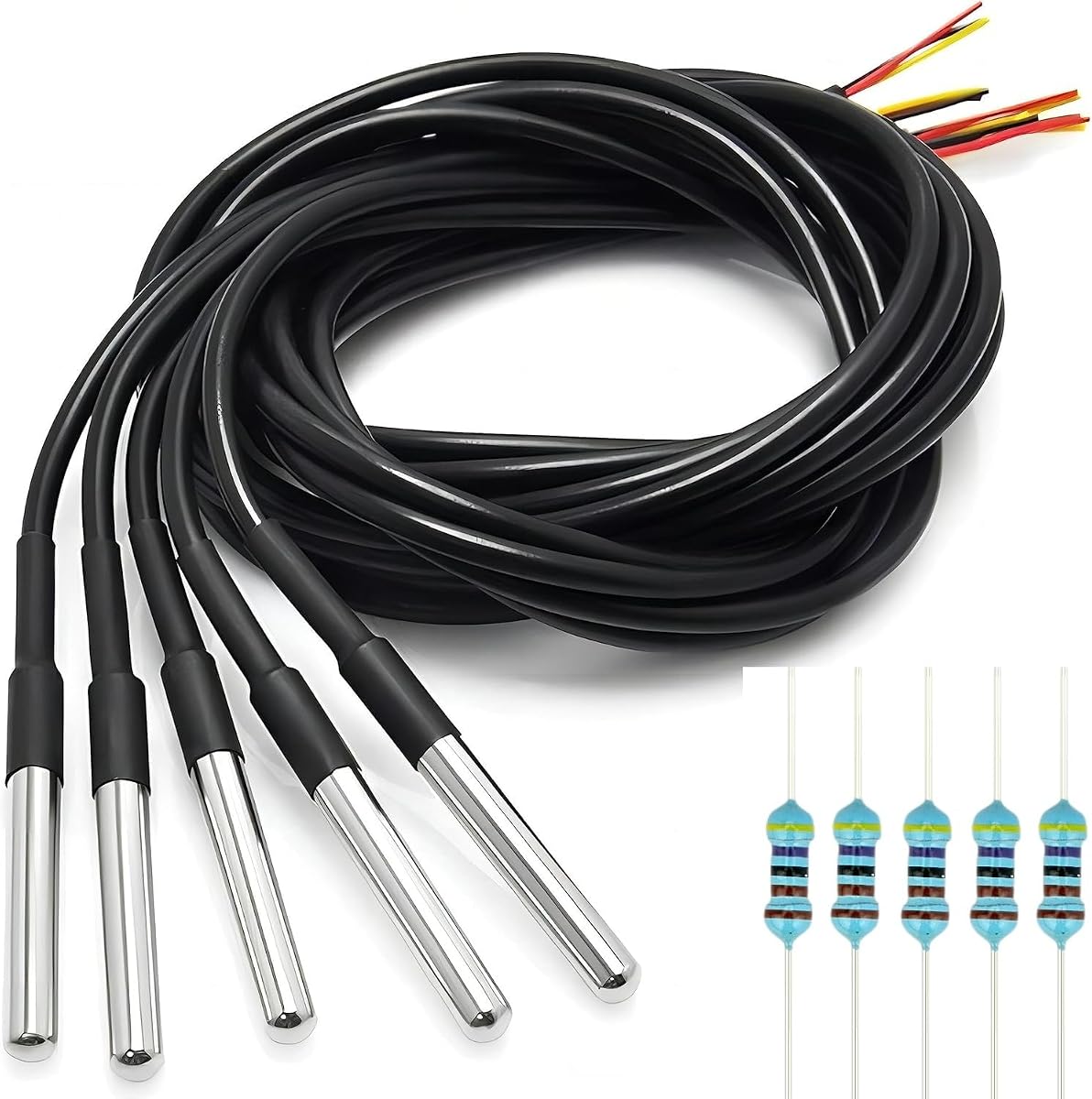
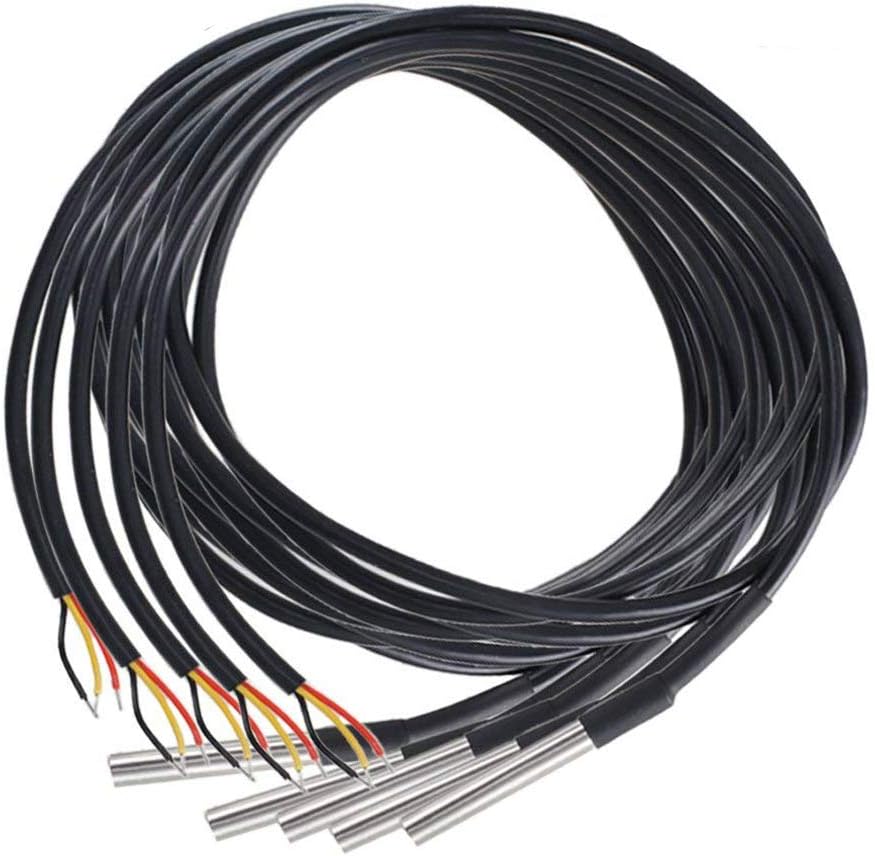
This DIY kit comes with five waterproof probes and the necessary resistors to make wiring them to your project much easier. The waterproof probe is designed for underwater use which expands the range of applications significantly.
We may earn a commission when you buy through this link, at no additional cost to you.
The accuracy is high at plus or minus 0.5 degrees across a wide range from negative 55 to positive 125 degrees Celsius. It is compatible with many popular platforms like Arduino Raspberry Pi ESP32 and STM for broad support.
The resistors are separate so you will need to add them manually to the circuit which adds a step to your assembly process. The packaging is basic so you need to keep track of the components carefully during storage.
If you are building multiple devices this kit saves you time searching for resistors individually for each unit. It is ideal for educational classes or bulk projects where you need many sensors at once.
Including resistors removes the hassle of sourcing them separately for your wiring needs.
Works seamlessly with various microcontrollers so you are not locked into one ecosystem.
We may earn a commission when you buy through this link, at no additional cost to you.
This bundle provides two reliable sensors with a digital output and pre-attached wires for easier connection to your project board. It uses dedicated digital modules to ensure high reliability and excellent long-term stability over time.
We may earn a commission when you buy through this link, at no additional cost to you.
The single-wire wiring scheme makes it very easy to integrate into applications where space is limited. It works with a range of 0 to 50 degrees and is a standard choice for basic humidity and temperature projects.
You only get two units which might not be enough if you need spares or to monitor multiple zones simultaneously. The temperature range is quite limited so it cannot be used in freezers or hot environments.
If you need a small batch to start a classroom project or a simple home monitor this is a good option. The inclusion of wires saves you time stripping and soldering your own connections.
Pre-attached wires mean you can plug in directly without extra assembly steps.
Designed with stable components that maintain performance over extended periods.
We may earn a commission when you buy through this link, at no additional cost to you.
This pack gives you five waterproof digital thermal probes which is great for bulk projects requiring multiple measurement points. The unique single bus interface means you can chain them on one data wire saving valuable pins on your board.
We may earn a commission when you buy through this link, at no additional cost to you.
It operates on a wide voltage range from 3.0V to 5.5V making it compatible with most development boards you might have. The one meter lead provides good reach for placing the probe in specific spots safely.
Note that the resistor is not included so you will need to add a 4.7K resistor between Data and VCC for testing. The wire length is fixed so you cannot adjust it to fit custom setups without modification.
This is the best choice if you want to build a network of sensors for monitoring different rooms or zones. The low component count makes wiring simple once you understand the bus protocol.
The single bus interface allows many sensors on one wire for efficient data collection.
Wide operating voltage ensures compatibility with both 3V and 5V systems easily.
We may earn a commission when you buy through this link, at no additional cost to you.
This module uses the high sensitive AM2302 chip to deliver better accuracy than the older DHT11 model for your projects. The temperature measurement accuracy is improved to plus or minus 0.5 degrees which is much more reliable for data logging.
We may earn a commission when you buy through this link, at no additional cost to you.
The humidity measuring range is 0 to 100% RH and humidity measurement accuracy is within 2% RH for solid performance. The single-bus digital signal output makes it easy to integrate into projects that need precise readings quickly.
It is slightly more expensive than the basic DHT11 but the accuracy gain is worth it for serious applications. The range is still limited compared to DS18B20 but covers most indoor and outdoor environments well.
If you need a budget-friendly sensor that still offers precise data this is a great middle ground. The fixing screw holes make mounting it securely much easier for permanent installations.
Better accuracy than standard budget sensors provides reliable data for monitoring tasks.
Integrated screw holes allow you to secure the module easily without tape or glue.
We may earn a commission when you buy through this link, at no additional cost to you.
This set includes five stainless steel waterproof temperature sensors which are ideal for a variety of measurement tasks. The wide temperature range from negative 55 to positive 125 degrees covers almost any environment you need to monitor.
We may earn a commission when you buy through this link, at no additional cost to you.
The waterproof package protects the internal components from damage due to water or moisture making it durable. It uses the single bus interface which keeps wiring simple when you want to connect multiple sensors to one port.
You will need to use a 4.7K resistor between Data and VCC to make testing and reading easier. The basic wire insulation might wear out over time if the wires are moved frequently during use.
If you need a standard reliable option for a bulk buy this bundle offers excellent value. It is a great choice for general monitoring where you need multiple sensors without buying individual probes.
Stainless steel waterproof packaging ensures durability in wet or demanding environments.
The single bus interface simplifies your circuit when adding multiple probes to a setup.
We may earn a commission when you buy through this link, at no additional cost to you.
Selecting the right sensor involves evaluating several key technical factors to match your project needs.
Accuracy is one of the most critical factors when choosing a temperature sensor for your Arduino projects. Some models like the DHT11 are only accurate to plus or minus 2 degrees Celsius while others like the AHT30 are accurate to plus or minus 0.3 degrees. If you are building a simple classroom thermostat the basic accuracy will suffice but for scientific data logging you should choose a high precision model.
Always check the accuracy specification before buying to ensure it meets your project tolerance levels.
The temperature range defines the limits between which the sensor can reliably measure. Budget sensors like the DHT11 usually measure from 0 to 50 degrees Celsius which is fine for indoor use but useless in a freezer. Waterproof probes like the DS18B20 can measure from negative 55 to positive 125 degrees making them suitable for extreme environments.
Make sure the sensor range covers the entire span of temperatures you expect to encounter in your application.
How the sensor talks to your Arduino matters for wiring complexity and pin usage. Some sensors use a single-wire digital protocol like the DHT series which is simple to code. Others use I2C which allows multiple sensors on just two wires but requires different libraries. The DS18B20 uses the 1-Wire protocol which is unique and allows daisy chaining on one pin.
Choose a protocol that matches your comfort level with coding and the number of pins available on your board.
If your project involves monitoring liquids or outdoor environments waterproof sensors are essential. Look for stainless steel or resin-sealed probes that are rated for submersion. Standard modules without protection will fail quickly if exposed to rain or humidity directly.
Select a waterproof model if there is any chance the sensor will touch water or sit in a wet location.
Ensure the sensor voltage matches your microcontroller logic levels to avoid damage. Most sensors work from 3.3V to 5V but some require specific ranges. Always check the power supply voltage in the product description before connecting.
A mismatched voltage can destroy the sensor so double check the electrical specs before wiring.
The physical size of the sensor matters if you have limited space in your enclosure. Modules like the DHT11 are small and easy to mount on breadboards while waterproof probes have cables that take up space. Consider how the sensor will be mounted in your final build.
Check the dimensions to ensure the sensor fits comfortably in your project housing.
Some kits come with extra components like resistors or adapter boards which save you a trip to the store. For example the DS18B20 kits often include pull-up resistors or adapter modules for easier wiring. Having these extras simplifies the setup process significantly for beginners.
Look for bundles that include necessary components to streamline your assembly time.
For projects that run continuously over months you need a sensor with stable long-term performance. Some sensors drift over time which can lead to inaccurate data unless recalibrated. Check user reviews or specs regarding long-term stability to avoid frequent replacements.
Prioritize models known for stability if your project will be running unattended for long periods.
Start by connecting the sensor wires to the correct pins on your Arduino board according to the product manual. Usually there is a power pin a ground pin and a data pin that need to be matched carefully.
Install the required library in your Arduino IDE to read data from the specific sensor model you purchased. Most sensors have well-documented libraries that simplify the coding process significantly.
Protect waterproof sensors from physical damage during use and store them in a dry place when not in use to maintain their longevity and accuracy.
The AHT30 and SHT31 modules are among the most accurate with readings within plus or minus 0.3 degrees Celsius. These are ideal for projects where precision is critical such as weather stations or scientific experiments.
Yes but you need to choose a waterproof model or seal the sensor properly. Standard digital modules like the DHT11 are not waterproof and will fail if exposed to rain or moisture directly.
Most modern sensors come pre-calibrated and do not require manual calibration. However for extreme precision applications you might verify readings against a known reference thermometer.
The DHT22 offers better accuracy and a wider temperature range than the DHT11. It costs slightly more but is worth it for projects requiring more reliable data.
Yes most of these sensors work with Raspberry Pi as well as Arduino. You will need to use the appropriate GPIO pins and libraries for the Raspberry Pi platform.
If using I2C or 1-Wire sensors you can connect multiple units to the same data pins. Each sensor has a unique address allowing the microcontroller to distinguish between them easily.
Most sensors work with the 5V or 3.3V power supply on your Arduino board. Ensure you check the specific voltage requirements in the product description before connecting.
Incorrect readings can be due to loose wiring missing resistors or interference. Check your connections and ensure you have installed the correct libraries for the sensor model.
The AHT30 offers the best balance of accuracy and ease of use for most modern Arduino projects requiring high precision. It is a fantastic choice for anyone looking to build a reliable monitoring system with minimal fuss.
If you need a budget solution the DHT11 is still a viable option for simple indoor projects where extreme precision is not required. It is cheap and widely supported by the community making it great for beginners.
For outdoor or industrial applications the waterproof DS18B20 probes are the most durable and versatile choice for long-term reliability. Always check the current prices and availability before purchasing to ensure you get the best deal.