
HP ZBook Firefly 14 G11
5.0Editor score
Intel Core Ultra 7 165U
32GB DDR5 RAM
14 inch WUXGA Display
MIL-STD-810H Certified
Choosing the right laptop for electrical engineering requires balancing raw processing power with portability for campus or fieldwork. You need a machine that handles complex simulations, circuit design software, and coding environments without lagging during critical project deadlines.
We evaluated ten top-rated models based on processor speed, graphics capabilities, memory capacity, and build quality. Our analysis focuses on devices that meet industry standards for engineering tasks, ensuring reliability for both students and working professionals in the field.
Each pick below showcases key strengths, real-world performance insights, and trade-offs to consider before buying. Prices and availability change frequently, so verify current details on the product pages before making your final decision for your specific engineering needs.
5.0Editor score

4.4Editor score

5.0Editor score
As an Amazon Associate we earn from qualifying purchases.
The following table provides a side-by-side comparison of all ten selected laptops, detailing their core specifications, display sizes, and key features to help you quickly identify the model that best fits your electrical engineering requirements.




The Dell Precision 7680 stands out as a powerhouse for electrical engineering tasks, boasting an Intel Core i9-13950HX processor and 32GB of DDR5 RAM. Its rating of 4.4 reflects strong user satisfaction with its ability to handle demanding workloads like circuit simulation and CAD design smoothly.
We may earn a commission when you buy through this link, at no additional cost to you.
This laptop is designed for advanced professional workflows, featuring ISV certifications that ensure compatibility with industry-standard software such as MATLAB and AutoCAD. The anti-glare display provides sharp visuals for detailed schematics, while the array of ports supports seamless integration with external hardware and testing equipment.
While it delivers exceptional performance, users should note that the device is heavier than portable ultrabooks, which may impact portability during daily commutes. Additionally, the price reflects its high-end workstation status, so it is best suited for users who prioritize raw power over lightweight convenience.
Ultimately, this laptop is ideal for electrical engineers and students who require reliable, high-performance computing for complex projects. Its durability and expandability make it a solid investment for those pursuing demanding technical careers or advanced research in the field.
The system architecture supports intensive multitasking, allowing engineers to run multiple simulation tools simultaneously without system lag or crashes.
Independent Software Vendor certifications guarantee that critical engineering applications run smoothly with optimized drivers and system resources.
We may earn a commission when you buy through this link, at no additional cost to you.
This variant of the Precision 7680 includes an NVIDIA RTX 1000 Ada GPU, making it particularly strong for tasks requiring 3D visualization or accelerated computing. With a rating of 4.3, it is well-regarded by engineers who need graphical fidelity alongside computational power for their daily workflows.
We may earn a commission when you buy through this link, at no additional cost to you.
The dedicated GPU enhances performance in rendering tasks and complex data visualizations, which are common in electrical engineering analysis. The system also includes enterprise-grade security features like BitLocker and robust connectivity options for connecting multiple high-resolution monitors for expanded workspace.
However, the processor is slightly less powerful than the i9 variant, which might limit pure CPU-bound calculation speeds. The cost is higher than standard models, so users should ensure they specifically need the RTX GPU for their software stack to justify the investment.
This laptop is recommended for electrical engineers who work heavily with graphical simulations or 3D modeling alongside traditional circuit design. It strikes a balance between portability and high-end graphics capabilities needed for specialized engineering applications.
The NVIDIA RTX card accelerates rendering and simulation tasks, reducing wait times for complex electrical design outputs.
Support for up to four external monitors allows for expansive workspaces to view schematics, data, and code simultaneously.
We may earn a commission when you buy through this link, at no additional cost to you.
The HP ZBook Firefly 14 G11 offers a balanced combination of performance and portability, ideal for engineers on the move. It holds a perfect 5.0 user rating, reflecting high satisfaction with its build quality and ability to run essential engineering software efficiently on the go.
We may earn a commission when you buy through this link, at no additional cost to you.
Despite its compact 14-inch form factor, it is ISV certified to run critical applications like AutoCAD and SolidWorks smoothly. The lightweight design and fast-charging battery make it easy to carry between classes or field sites without sacrificing the reliability expected from a professional workstation.
Users should be aware that it uses integrated graphics, which may not handle heavy 3D rendering or intensive simulation tasks as well as dedicated GPU models. The smaller screen might also require more scrolling for large schematics compared to larger 16-inch laptops.
This laptop is perfect for students or professionals who prioritize mobility and daily usability over raw graphical horsepower. It is a reliable choice for those who need a durable, efficient machine for standard electrical engineering tasks without the bulk of larger workstations.
Weighing only 3.13 lbs, this laptop is easy to carry in a backpack for daily travel to labs or client sites.
Certifications ensure that industry-standard engineering tools run without compatibility issues or performance bottlenecks.
We may earn a commission when you buy through this link, at no additional cost to you.
The Lenovo ThinkPad P16s Gen 4 combines a larger 16-inch workspace with a relatively portable chassis, offering a spacious view for complex engineering diagrams. It features Wi-Fi 7 for faster wireless connections, which is beneficial for cloud-based collaboration and large file transfers.
We may earn a commission when you buy through this link, at no additional cost to you.
With ISV certifications and Windows 11 Pro, it ensures reliable performance for professional applications and secure enterprise features like BitLocker encryption. The keyboard is backlit, making it comfortable to type code or reports in various lighting conditions throughout the day.
It scores a 4.0 rating, indicating solid performance but with some limitations compared to higher-end models. The integrated graphics are suitable for general design tasks but may struggle with heavy 3D modeling or advanced simulation workloads common in electrical engineering.
This model is recommended for engineers who need a reliable, slightly larger screen for productivity without the weight of a heavy desktop replacement. It is a practical choice for daily office work or academic studies where portability and screen real estate are both priorities.
Wi-Fi 7 support ensures future-proof high-speed wireless connectivity for seamless cloud syncing and video conferencing.
Windows 11 Pro with BitLocker and remote desktop features provides robust security for sensitive engineering data and work.
We may earn a commission when you buy through this link, at no additional cost to you.
This model stands out with an impressive 64GB of DDR5 RAM and an NVIDIA RTX 2000 Ada GPU, making it ideal for extremely demanding workflows that require vast memory and graphics power. It has earned a perfect 5.0 rating from users who appreciate its robust build and high-end specifications.
We may earn a commission when you buy through this link, at no additional cost to you.
The combination of high-end GPU and massive memory allows engineers to run multiple complex simulations, virtual machines, and rendering tasks simultaneously without slowdowns. The system is ISV certified, ensuring that professional engineering software performs reliably under heavy loads.
The main trade-off is the significant cost and weight associated with such high-end components, which may not be necessary for all users. Those with basic electrical engineering tasks might find this overkill, while professionals with heavy data processing needs will value its capabilities.
It is the top choice for engineers who prioritize maximum performance and future-proofing for their workstations. If your workflow involves heavy simulation, large datasets, or advanced rendering, this machine offers the reliability and power needed to excel.
64GB of RAM ensures smooth multitasking across multiple heavy engineering applications and virtual environments simultaneously.
The RTX 2000 Ada GPU accelerates rendering and data visualization tasks significantly faster than standard integrated graphics.
We may earn a commission when you buy through this link, at no additional cost to you.
This configuration offers a balanced mix of GPU power and storage capacity, featuring the NVIDIA RTX 2000 Ada and a generous 2TB SSD for large project files. While the user rating is slightly lower at 3.9, it remains a capable workstation for specific professional needs.
We may earn a commission when you buy through this link, at no additional cost to you.
The RTX GPU enables efficient handling of graphical engineering tasks, while the 2TB SSD ensures you have ample space for storing extensive datasets and software libraries. The full-size keyboard with a numeric keypad is particularly useful for data entry and technical calculations.
Users may find the lower rating reflects issues with specific configurations or support experiences, so checking warranty details is advisable. The weight is typical for this class of workstation, meaning it is better suited for fixed setups than frequent travel.
This laptop is a solid choice for professionals who need strong graphics performance and large local storage without the top-tier RAM upgrade. It is well-suited for engineers who store massive project archives locally and rely on GPU acceleration for rendering work.
The 2TB SSD provides extensive storage for large engineering files and software installations without needing external drives.
A full-size keyboard with dedicated numpad improves efficiency when entering numerical data or performing quick calculations.
We may earn a commission when you buy through this link, at no additional cost to you.
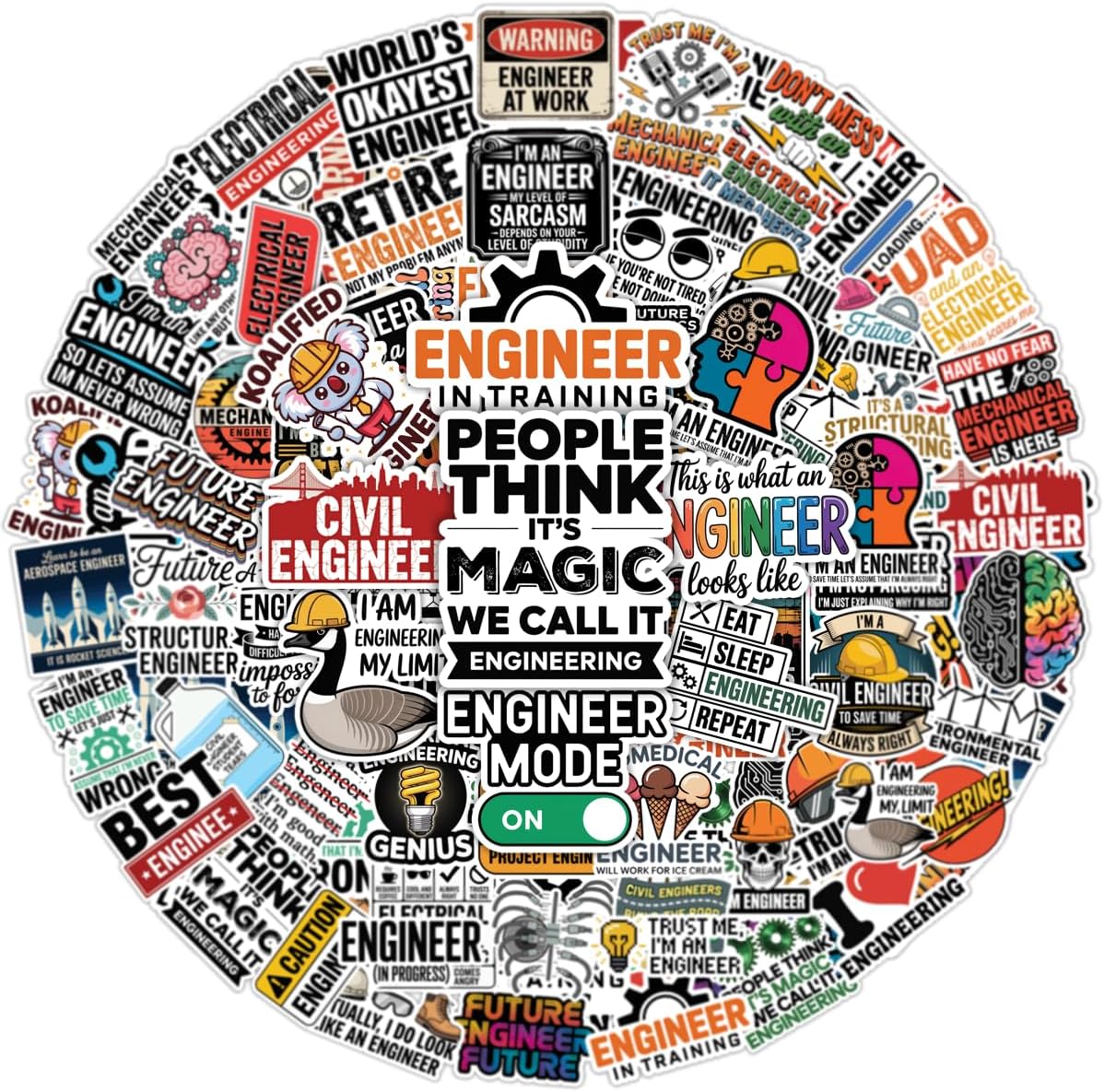
While not a laptop, these stickers serve as a fun and practical accessory for engineers to personalize their workspace or laptop. The set includes 64 pieces featuring various engineering themes, from electrical to robotics, and is designed to stick firmly to any clean surface.
We may earn a commission when you buy through this link, at no additional cost to you.
The vinyl material is waterproof and scratch-proof, ensuring that the designs remain vibrant even with daily use or outdoor exposure. This makes them ideal for customizing laptops, water bottles, or toolboxes that accompany students and professionals on their daily journeys.
Some users might find the value limited to decoration since they do not offer technical utility or computing power. However, for the price, they offer a creative way to express professional pride and add a touch of personality to standard equipment.
These stickers are perfect for students looking to customize their gear or for those seeking a unique gift for an engineer. They are a simple yet effective way to show support for STEM education and celebrate the diverse fields within engineering.
Personalize your work equipment with durable decals that reflect your specific engineering discipline and style.
Made from premium PVC vinyl, these stickers are weather-resistant and do not peel easily under normal conditions.
We may earn a commission when you buy through this link, at no additional cost to you.
The Dell Precision 7780 boasts a large 17.3-inch display, offering significant screen real estate for detailed engineering schematics and multi-window workflows. Powered by an i9 processor and RTX GPU, it delivers high performance for rendering and simulations, though it lacks a specific user rating due to limited sales data.
We may earn a commission when you buy through this link, at no additional cost to you.
Its massive screen and high-end specs make it ideal for desktop replacement scenarios where portability is less of a concern. The support for up to four external monitors adds to its utility, allowing for a sprawling workspace setup in a lab or office environment.
The trade-off for this size and power is significant weight and bulk, making it impractical for daily commuting or travel. It is best suited for users who require a stationary high-performance machine that offers the best of a desktop and laptop combined.
This model is recommended for engineers who need a large viewing area and strong graphics performance for fixed locations. If you prioritize screen space and raw power over portability, this laptop provides a robust solution for complex engineering tasks.
The 17.3-inch display reduces eye strain during long sessions by offering a larger area to view detailed designs.
High-end components allow this device to replace a desktop workstation for intensive design and calculation tasks.
We may earn a commission when you buy through this link, at no additional cost to you.
This set of three stickers features humor related to electrical engineering concepts like volts and ohms, making it a fun way to personalize gear. It holds a 5.0 rating, indicating that buyers appreciate the design and quality as a gift for students or professionals.
We may earn a commission when you buy through this link, at no additional cost to you.
Made from high-quality waterproof vinyl, these stickers are designed to withstand tough conditions and remain intact even in harsh work environments. Their easy application and removal make them perfect for laptops, hard hats, or toolboxes without leaving residue.
While they offer no technical benefit, their value lies in community building and adding personality to standard equipment. A small quantity might limit creative options, but the specific electrical theme makes them a targeted and appreciated gift for the field.
These stickers are ideal for teachers, students, or anyone looking to add a touch of humor to their work environment. They serve as a lighthearted nod to the challenges and fun of electrical engineering and related STEM disciplines.
Light-hearted quotes about physics concepts bring a smile to engineers who deal with technical stress daily.
Perfect as a small token gift for birthday exchanges, graduation celebrations, or end-of-year student rewards.
We may earn a commission when you buy through this link, at no additional cost to you.
The HP OmniBook 3 offers a large 17.3-inch screen and a lower price point, making it accessible for students on a budget. With a 4.5 rating, users appreciate its everyday performance and battery life, which are suitable for lighter tasks and general coursework.
We may earn a commission when you buy through this link, at no additional cost to you.
It features noise reduction and HDR video calls, which help during remote learning or virtual meetings. The 512GB SSD provides decent storage for documents and light applications, and the long battery life supports all-day use without constant recharging.
However, it is not powerful enough for heavy CAD or complex simulations due to only 8GB of RAM and basic integrated graphics. Users planning to run professional-grade engineering software might find it struggles with performance during intensive work sessions.
This laptop is best for introductory engineering courses or general productivity tasks where budget is a priority. It serves as a practical starting point for those who do not yet need the full horsepower of a high-end workstation for their studies.
Up to 14 hours of battery life ensures you can work through lectures or field tasks without carrying a charger.
Lower cost makes this accessible for students who need a reliable machine without breaking their initial budget.
We may earn a commission when you buy through this link, at no additional cost to you.
Selecting the right laptop for electrical engineering involves evaluating several key factors that impact your ability to run specialized software and handle complex projects effectively. This guide outlines the most important aspects to consider before making your purchase.
The processor is the brain of your laptop and directly affects how quickly it can handle computations and simulations. Look for high-end CPUs like Intel Core i7 or i9, or AMD Ryzen 7 and 9 series to ensure smooth operation during complex engineering tasks.
Prioritize processors with multiple cores and high clock speeds to manage multitasking and data processing efficiently.
If you plan to use 3D modeling or rendering software, a dedicated GPU is essential for accelerating graphical performance. NVIDIA RTX series cards are particularly well-suited for professional workloads and offer better stability for engineering applications.
Ensure the laptop supports hardware acceleration to avoid bottlenecks when working with visual data or simulations.
Adequate RAM is critical for running multiple applications simultaneously without slowdowns. Aim for at least 32GB of DDR5 RAM to handle modern engineering software demands, and ensure your storage is a fast SSD for quick file access.
Select a storage solution with enough capacity to store large datasets and project files locally without needing external drives.
A high-resolution, anti-glare display helps reduce eye strain during long hours of designing and reading schematics. Look for screens with accurate color reproduction and sufficient brightness to view details clearly in various environments.
Prioritize a larger screen size or the ability to connect external monitors for expanded workspace and better productivity.
Consider the weight and size of the laptop if you plan to carry it to classes or field sites regularly. A durable build quality that withstands daily wear and tear is important for professional and academic use.
Balance the need for powerful specs with portability to ensure you can use the laptop comfortably in different settings.
ISV certification guarantees that the laptop is tested and optimized to run specific professional software reliably. This is crucial for ensuring that engineering applications like AutoCAD or MATLAB perform without errors on your device.
Check the manufacturer's compatibility list to verify your key software is officially supported for optimal performance.
Sufficient ports like USB, HDMI, and Ethernet are necessary to connect peripherals, test equipment, and external displays. Look for Thunderbolt support for fast data transfer and versatile connectivity with modern accessories.
Ensure the laptop supports fast Wi-Fi to stay connected in labs or offices where internet access is essential.
Long battery life allows you to work unplugged for extended periods, which is valuable during lectures or field work. Look for models that offer fast charging capabilities to minimize downtime between uses.
Prioritize efficiency-focused processors and larger battery capacities to maximize your usage time without carrying a charger.
Keep your laptop in a safe environment away from dust, heat, and direct sunlight to maintain hardware integrity and performance. Avoid exposing the device to moisture or liquids which can damage internal components and shorten its lifespan.
Install regular software updates and security patches to ensure your system remains protected against threats and runs smoothly. Use official software drivers from the manufacturer to maximize compatibility and performance with engineering applications.
Regularly clean the keyboard and screen with a soft, lint-free cloth to remove dirt and fingerprints. Proper maintenance helps prevent hardware degradation and ensures a pleasant working experience for years to come.
For electrical engineering, a minimum of 16GB is acceptable for basic coursework, but 32GB is recommended for smoother multitasking and complex simulations. Higher-end workloads like large circuit simulations may benefit from 64GB for maximum efficiency.
Basic circuit design does not require a dedicated GPU, as integrated graphics can handle standard tasks. However, if you work with 3D visualization or heavy simulations, a dedicated NVIDIA RTX GPU will provide significant performance benefits.
Dell Precision and HP ZBook are highly popular among engineers due to their ISV certifications and robust build quality. Lenovo ThinkPad P-series is also favored for its durability and professional feature set.
Yes, MacBooks can handle many engineering tasks like programming and basic circuit design efficiently. However, some specialized Windows-only engineering software may require virtualization or a dedicated Windows laptop for full compatibility.
ISV certification ensures that your laptop is optimized to run professional engineering applications reliably without crashes. It is highly recommended for professional use to guarantee stability and compatibility with essential tools.
A screen size of 15 to 16 inches is ideal for viewing detailed schematics comfortably without feeling cramped. Larger screens like 17 inches can provide more space but may impact portability significantly.
It depends on your workflow; prioritize performance if you work mostly at a desk or lab station. Prioritize battery life if you frequently travel to classes or field sites where access to power outlets is limited.
Yes, budget laptops are suitable for introductory courses and general coding tasks. However, ensure they meet minimum requirements for software like MATLAB to avoid performance issues as coursework becomes more complex.
Choosing the right laptop involves balancing raw processing power with portability depending on your specific engineering needs. The Dell Precision and HP ZBook models offer strong performance with certified reliability for professional and student workflows alike.
Prioritize a laptop with at least 32GB of RAM and a dedicated GPU if you plan to run heavy simulations or 3D rendering regularly. Consider the screen size and connectivity options to ensure your device supports your preferred workspace setup.
Prices and availability for these models can fluctuate frequently, so always check current listings before finalizing your purchase. This guide provides a solid foundation to help you find the most capable machine for your electrical engineering journey.